



Customer story
CreditGUARD
Recovery after ransomware
Read how CreditGUARD recovered from a ransomware attack with Catalogic DPX.
Catalogic DPX
Protect virtual machines, physical servers, applications, and storage with a recovery plan that fits your infrastructure.
Built for IT teams managing multiple platforms, existing storage investments, and long-term retention requirements.
Customer experiences with daily backup operations and ransomware recovery.
Customer story
CreditGUARD
Read how CreditGUARD recovered from a ransomware attack with Catalogic DPX.

Customer perspective
Southern Utah University
We don't need to watch over it or restart jobs anymore.
Assistant Director of IT Operations
Evaluate DPX against the workloads you protect, the infrastructure you own, and the recovery tasks your team needs to perform.

Bring VMware, Hyper-V and Proxmox VM protection together with physical server, application and NAS backup. Review the supported backup method for each workload before planning your deployment.

Deploy the vStor backup repository on a physical server or as a virtual appliance in VMware or Hyper-V. Plan capacity and performance around the workloads you need to protect.

Recover selected files when data is missing, restore a VM after a workload failure, or use Bare Metal Recovery to rebuild a supported physical system. Available restore paths depend on the backup type and platform.

Apply vStor snapshot deletion locks with MFA enabled, choosing fixed or flexible protection. For longer retention, archive supported block and VMware backups to cloud storage or tape.
Find the task first, then drill into the details that matter to your environment.

01 / Everyday protection
Protect workloads across sites and storage systems with scheduled policies.
02 / Recovery operations
Match the recovery path to the incident, from individual files to a rebuilt server.

03 / Cyber resilience
Keep recoverable copies and clear restoration options when production is disrupted.
New in this release: expanded virtualization coverage and recovery workflows.
See what’s new ↗DPX 4.16 extends agentless protection to Proxmox and adds security, compliance, and recovery controls across VMware, vStor, and tape.

Protect Proxmox virtual machines without agents, with full and incremental backups to vStor and node management from the web UI.

Back up and restore VMware virtual machines protected with a Virtual Trusted Platform Module.

Capture a full audit trail of REST and system-level actions, with configurable retention, filtering, and CSV export.

Manage tape registration, import and export slots, and automated library scans entirely from the web console.
Read the release overview for the full list of changes, or see when a Proxmox estate needs more than Proxmox Backup Server alone.
See when multi-hypervisor estates, long retention, immutability, and central reporting call for Catalogic DPX 4.16 instead of Proxmox Backup Server alone.
Explore agentless Proxmox backup, vStor audit logging, VMware vTPM support, and expanded disaster recovery and tape library management.
DPX provides robust backup and recovery capabilities. Patented block-level protection reduces backup time and impact by 90%, for both physical and virtual servers. Files and applications are easily recovered directly from backup storage. The vStor backup repository is a flexible and scalable software-defined backup target that frees you from expensive backup appliances and vendor lock-in.
DPX GuardMode provides an additional layer of ransomware detection to backup teams by proactively monitoring for suspicious activity and encrypted files. When ransomware strikes, DPX provides a list of affected files to restore and multiple recovery points so you can spin the clock back to just before the infection happened. Backups are stored as immutable snapshots with offline, air-gapped copies.
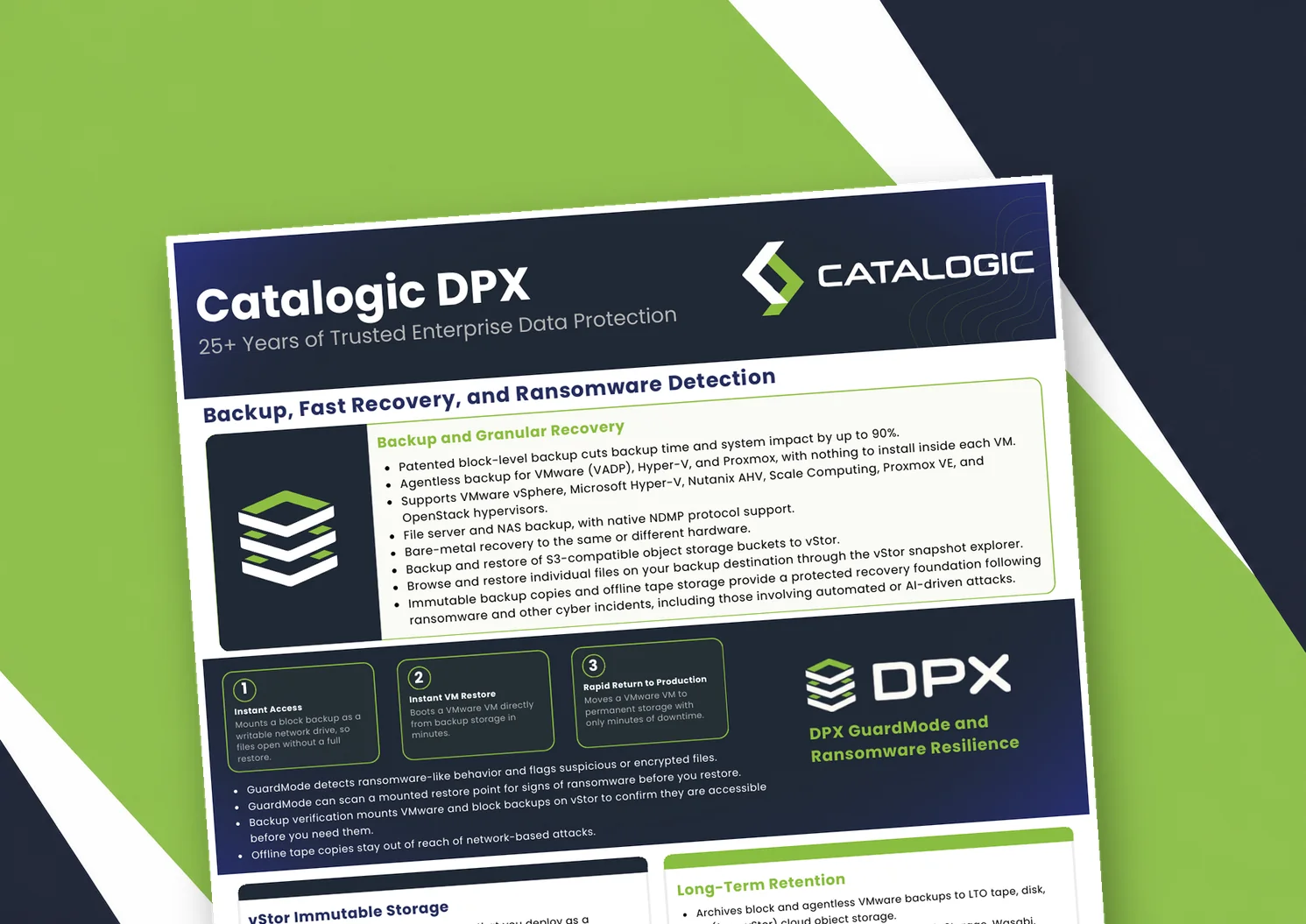
Catalogic DPX product brief: block-level and agentless VM backup, Instant VM Restore, GuardMode ransomware detection, immutable vStor storage, and long-term retention to tape or cloud.
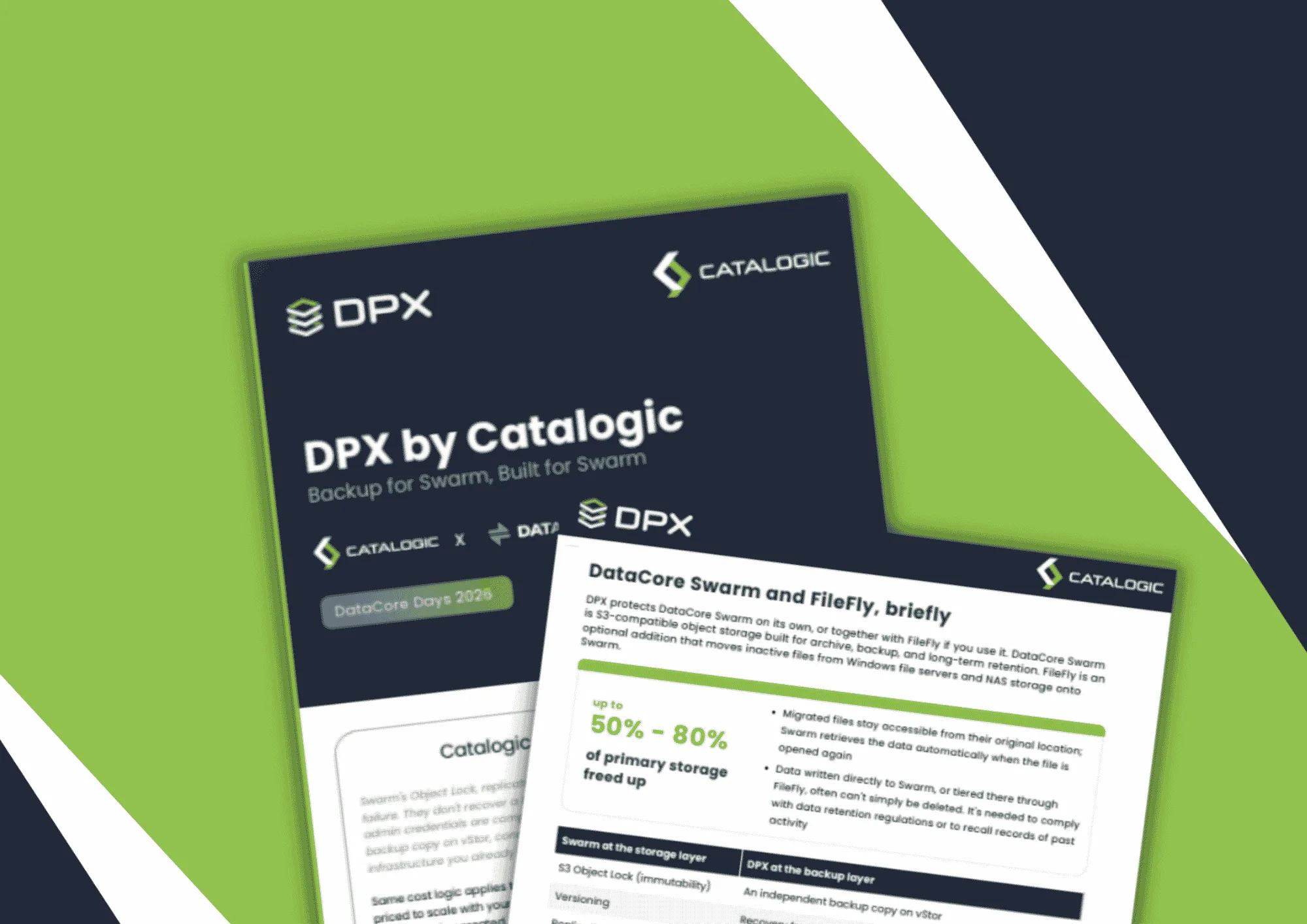
Product brief: DPX adds an independent, S3-connected backup copy on vStor for DataCore Swarm data, with licensing that scales with deployment size to protect partner margin.
DPX 4.16 adds agentless Proxmox VE backup to Catalogic's enterprise data protection platform, giving mixed VMware, Hyper-V, and Proxmox estates a single console for backup, recovery, and ransomware resilience.
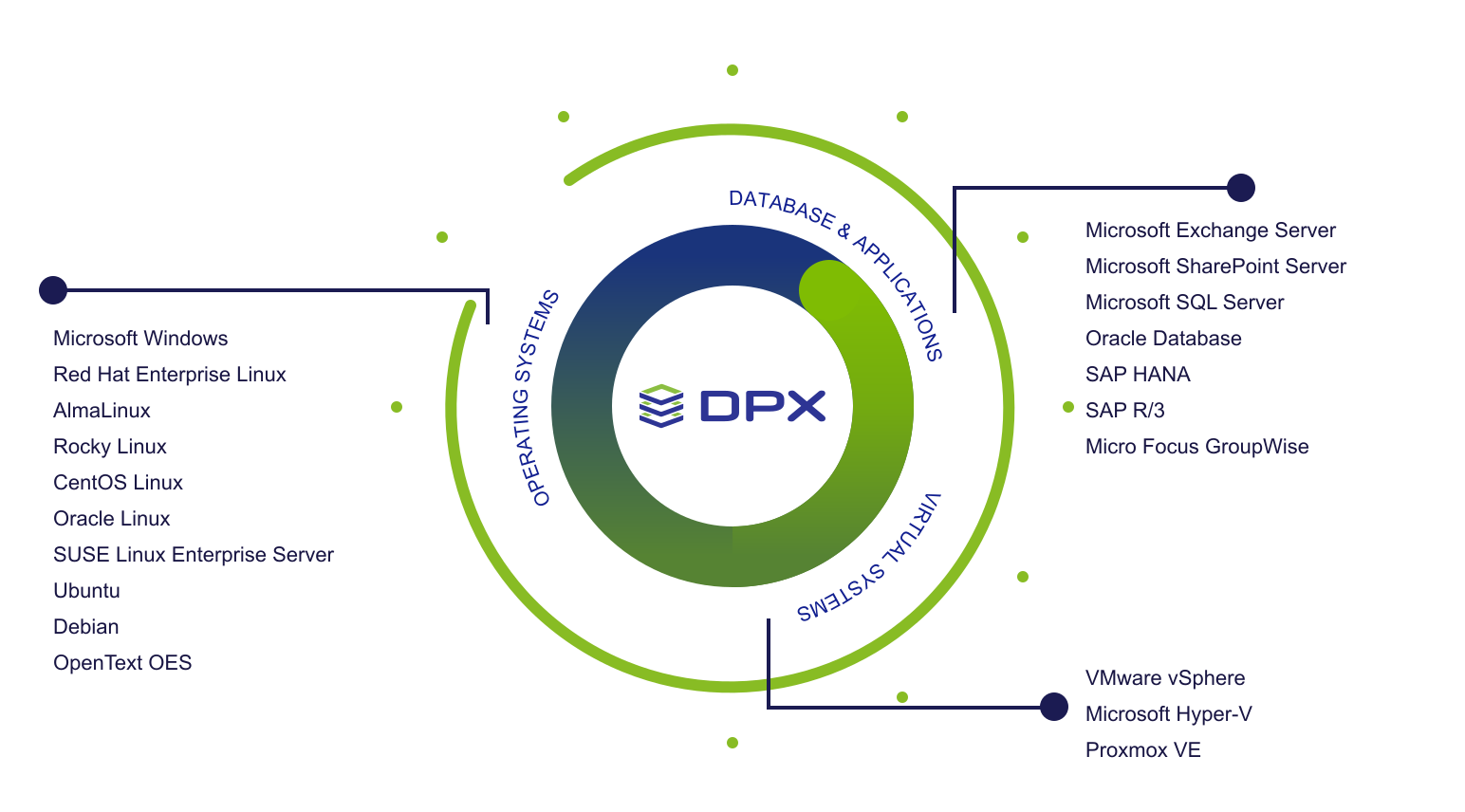
Catalogic's enterprise data protection solution offers broad platform compatibility with your network, servers, applications, and databases. For information on how to deploy DPX and for compatibility information, please see our documentation.
| Type | DPX Master Server | DPX vStor Server | Client |
|---|---|---|---|
| Deployment | Virtual appliance for VMware (.OVA) or Hyper-V (.ISO), or hardware-agnostic .ISO on a physical or virtual machine. Installation on Windows is not supported. | Virtual appliance for VMware or Hyper-V, or vStor for Linux on a physical machine | Please refer to the latest Compatibility Guide |
| Memory | 16 GB | 16 GB (virtual appliance). vStor for Linux: at least 32 GB without deduplication, 64 GB with deduplication | 2 GB minimum, 4 GB recommended for Enterprise Applications |
| Processor | 4 CPUs | 4 virtual CPUs (virtual appliance). vStor for Linux: at least 4 CPUs or cores | 1 Core minimum |
| Architecture | x64 required | x64 required | Please refer to the latest Compatibility Guide |
| Disk Space | 270 GB (virtual appliance). Physical appliance: minimum 70 GB for the operating system | 50 GB system disk and 100 GB starter disk (virtual appliance) | 4 GB minimum free space on system drive for installation* |
| Network | 10 Gbps recommended, 1 Gbps minimum | 10 GbE recommended | Please refer to the latest Compatibility Guide |
| Operating System | AlmaLinux 8.10, included in the appliance | Please refer to the latest Compatibility Guide | Please refer to the latest Compatibility Guide |
*Note: For Windows clients with limited disk space, a client-only installer is available, which requires only 1.2 GB of temporary free space on the system drive. For details and restrictions, see the DPX Deployment Guide.
The above recommended configuration can support an enterprise with up to 300 clients. Larger enterprises can be accommodated by introducing additional master servers. DPX performance is dependent on backup job configuration and scheduling. The above recommended configuration is able to support approximately 25 concurrent jobs, with each job backing up one client.
The master server may be virtualized; however, the specified resources must be reserved for the virtual machines serving in this capacity. Please consult your virtualization vendor (e.g., VMware, Microsoft) to review the supportability of tape libraries or tape drives by the guest OS where you plan to install the master server. For example, fiber channel tape devices are not supported by VMware ESX Server.
Since backup and restore performance is highly dependent on disk and network I/O, choice of storage subsystems, network infrastructure components, as well as applicable configuration parameters for each will determine actual performance within specific IT environments.
Talk to Catalogic
Bring your workload list and recovery objectives. We’ll walk through the relevant backup and restore workflows and discuss your storage requirements.
Request a demo