

Granular recovery technology lets you recover selected data from a backup, such as a file or directory, without restoring the whole machine. If someone deletes a report from a working VM, recovering that report avoids rolling the VM back and losing unrelated changes made since the backup.
The restore method depends on how the data was backed up. Catalogic DPX has separate workflows for file backups, files within block backups, and agentless VM backups. Application recovery uses its own procedures. This guide explains how to choose a workflow and what to check before running it.
When granular recovery is useful
A file restore fits an incident where the system still works and the missing or damaged data is identifiable. Examples include an accidentally deleted folder or a configuration file that needs to be recovered from an earlier version.
Choose a recovery point from before the deletion or corruption. Before writing recovered files back, check whether the destination contains newer data that should be kept. Open the recovered files and confirm that they contain the version you intended to retrieve.
When the operating system or the whole machine needs rebuilding, use a full-system recovery method. The bare metal recovery guide explains that process and how it differs from file recovery.
Choosing a granular recovery workflow in DPX
| Backup source | Restore mode | What to check |
|---|---|---|
| DPX file backup | File Restore from File Backup | The required file version is available and the tape or disk holding it is accessible. |
| DPX block backup protected by an agent | File Restore from Block Backup | Select the source volume and recovery point, then browse for the files. |
| VMware or Hyper-V agentless backup | Agentless File Restore | The backup is on vStor and the guest storage can be mounted by this workflow. |
| Application backup | Application-specific restore | Follow the procedure and compatibility requirements for that application. |
The DPX granular restore and disaster recovery page covers where these methods fit alongside broader recovery options.
File recovery from block backups
DPX can restore selected files or directories from block backups protected by DPX agent workloads. In the web interface, the restore wizard lets you choose a node, volume and recovery point before browsing the data. If file history was disabled for the backup, the snapshot must be mounted to browse its contents. See the File Restore from Block Backup documentation.
For example, if a configuration file is damaged, you can retrieve an earlier version of that file from a block backup. Check the recovered version before putting it back into use.
Restoring files from a block backup
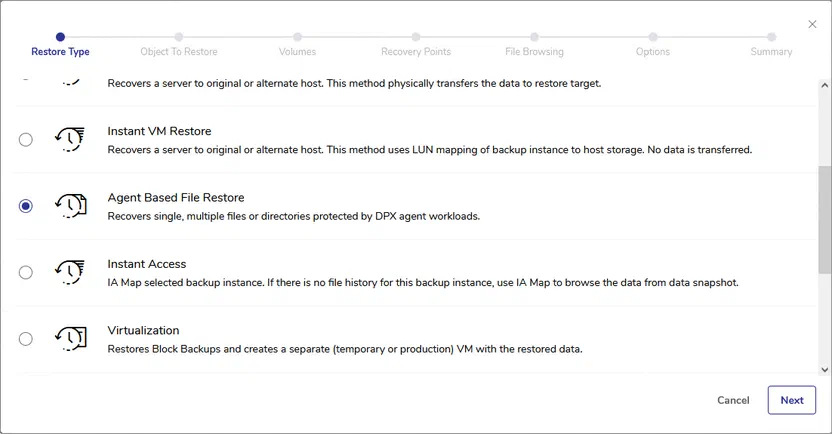
The following steps describe File Restore from Block Backup in the DPX 4.16 web interface. The screenshots come from an earlier interface, where this mode was labelled Agent Based File Restore. Refer to the linked documentation for the current screens.
- Open Job Manager and select New Restore Job.
- Choose File Restore from Block Backup.
- Select the node containing the data, then the volume you want to browse.
- Choose the recovery point from which to retrieve the files.
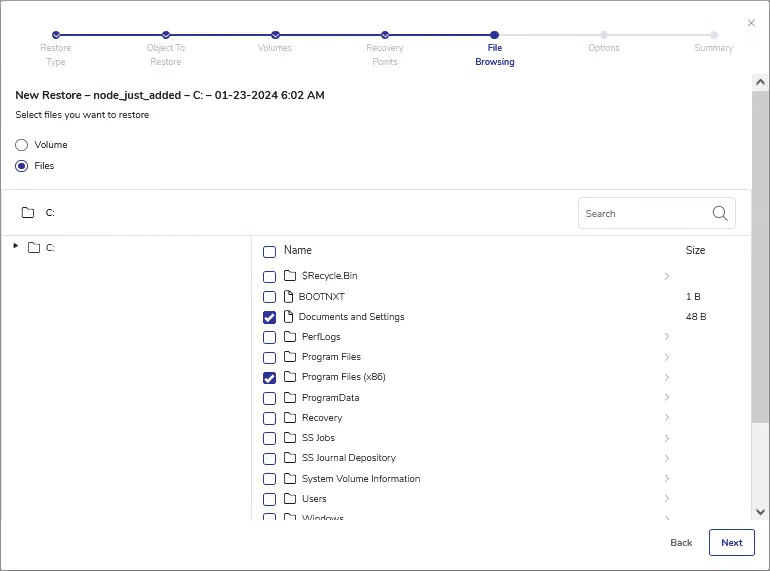
- In File Browsing, select the files or directories needed. Mount the snapshot first if file history was disabled.
- Enter a job name and review the restore options, including the destination and notification settings.
- Save the job. Run it immediately when prompted, or run it later from Job Manager.
The file browser lets you select individual directories within the chosen volume.
Review the destination settings before running the job. Restoring to a separate location gives you a place to inspect the recovered data before replacing files in use. Alternate destinations must use similar operating systems; this workflow does not support restoring Linux files to a Windows node or the reverse.
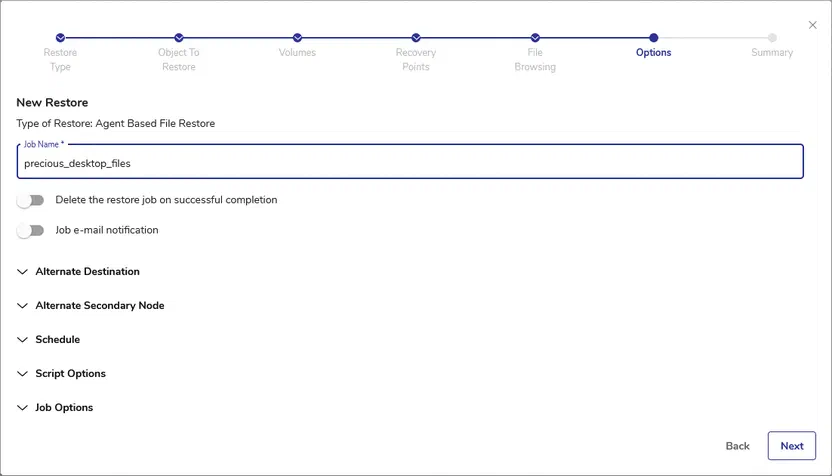
For destination settings and overwrite behavior, consult the advanced job options.
Recovering files from VMware and Hyper-V backups
Agentless File Restore mounts a VM backup so you can browse its contents and download selected files. The backup target must be Catalogic vStor. The documented mounting workflow does not support ReFS, Btrfs or LVM storage.
In Job Manager, create an Agentless File Restore job and select the VM and recovery point. Click Mount Image, browse the mounted data and select the required files or directories. Click Restore to download the selection through your browser. Multiple files can be downloaded as a ZIP archive.
This workflow delivers files to your browser’s download folder. You then place them in the required destination and check that they are usable. The documentation specifies a 2 GB limit for a single file downloaded through the browser; consult its ZIP archive guidance when recovering larger selections.
The Agentless File Restore documentation includes the mounting restrictions and download details.
Restoring files from a file backup
For data protected by a file backup job, choose File Restore from File Backup in Job Manager. Select the files or directories and use Backup Date/Time to choose an earlier version when one is available. Review the job options and destination before saving and running the restore.
The tape or disk holding the backup must be accessible and healthy. If the backup is on off-site tape, allow time to retrieve the media before the restore. See the File Restore from File Backup documentation for selection options and destination requirements.
Application recovery and its limits
DPX documents application restore support for Oracle Database, Microsoft SQL Server, SAP HANA, SAP R/3, Microsoft Exchange Server, Microsoft SharePoint Server, GroupWise, and HCL Notes and Domino. Supported application and operating system versions depend on the DPX compatibility matrix.
The recovery options differ by application. Support for restoring an application does not establish that every record or object within it can be restored separately. Use the application’s documented restore procedure to determine what can be selected, where it can be restored and what configuration is required.
Start with the Application Restore documentation and follow the procedure for your workload.
Planning a restore test
Test the recovery method you expect to use during an incident. For a file recovery test, choose a known file version, restore it to a test destination and check its contents and permissions. Record how long the process takes, including any wait for backup media or snapshot mounting.