

Virtualized healthcare infrastructure
Protect VMware, Hyper-V, and Proxmox environments with DPX backup and recovery for clinical applications, administrative systems, departmental servers, and infrastructure services.
Healthcare data protection

Healthcare IT teams protect systems that cannot remain offline for long. EHR infrastructure, imaging workflows, file shares, lab systems, billing platforms, identity services, databases, virtual machines, and collaboration systems all contribute to care delivery and daily operations. A ransomware attack, failed patch, accidental deletion, storage outage, or site-level incident can affect appointments, diagnostics, medication workflows, claims processing, patient communication, and access to records. Catalogic helps healthcare IT teams build backup and recovery architecture that supports continuity, audit readiness, and cyber-resilient operations.
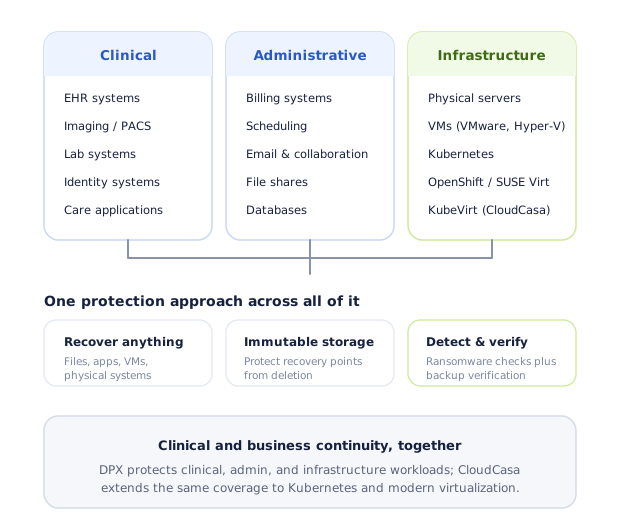
Catalogic protects the infrastructure behind clinical and administrative operations, including legacy systems, virtual platforms, NAS, databases, and cloud-native environments.
Protect VMware, Hyper-V, and Proxmox environments with DPX backup and recovery for clinical applications, administrative systems, departmental servers, and infrastructure services.
Protect Microsoft Windows, Red Hat Enterprise Linux, SUSE Linux, Ubuntu, Oracle Linux, Rocky Linux, AlmaLinux, and other supported systems used across healthcare IT environments.
Support recovery workflows for SQL Server, Exchange, SharePoint, Oracle Database, SAP HANA, SAP R/3, and other supported enterprise applications.
Protect file shares, departmental data, imaging-adjacent repositories, home directories, and large unstructured data sets with DPX file, NAS, and NDMP-oriented workflows where appropriate.
Use CloudCasa to protect Kubernetes resources, persistent volumes, namespaces, application configurations, KubeVirt VMs, OpenShift Virtualization, and SUSE Virtualization.
Use flexible backup repositories, replication, archive, and restore options to protect data across hospitals, clinics, labs, and smaller remote locations.
Healthcare ransomware response depends on more than having a backup job that completed last night. Recovery points need to survive the incident, remain restorable, and give IT teams a way to recover without reintroducing compromised data. DPX, vStor, and GuardMode help healthcare IT teams improve ransomware recovery readiness. vStor provides software-defined immutable backup storage with deletion lock controls. GuardMode monitors ransomware-like behavior before backup. DPX adds backup verification, malware-aware recovery workflows, multiple recovery points, and recovery options for physical, virtual, and application workloads.
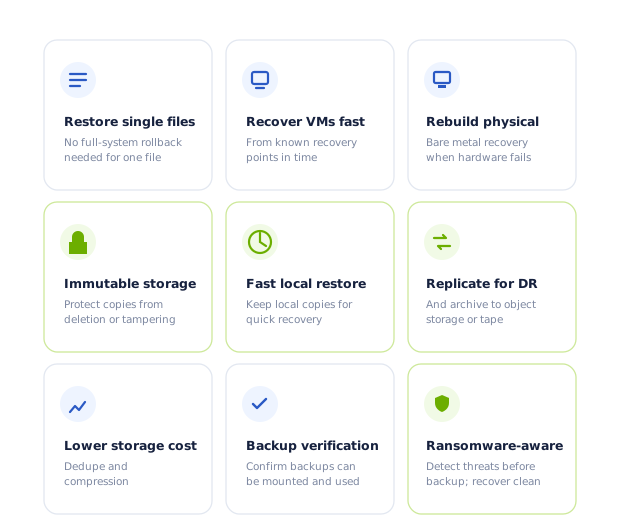
Use DPX for the systems that support clinical and administrative operations: physical servers, virtual machines, file systems, NAS, Microsoft workloads, databases, and application servers. DPX is designed for backup, rapid restore, granular recovery, bare metal recovery, archive, replication, and ransomware-aware recovery.
Use CloudCasa for Kubernetes, KubeVirt, OpenShift Virtualization, SUSE Virtualization, and cloud-native application environments used by platform, development, analytics, and research teams. CloudCasa supports multi-cluster management, centralized policies, backup, recovery, migration, and disaster recovery across on-premises, cloud, and hybrid environments.
Healthcare buyers want confidence that critical systems can be restored, recovery points are protected, and backup operations support internal governance, audit, and continuity objectives.
Use this section as a practical routing table for different healthcare organizations and workloads.
| Environment | Recommended Catalogic fit | Why it matters |
|---|---|---|
| Hospitals and health systems | DPX plus vStor and GuardMode | Protect mixed physical, virtual, NAS, database, and Microsoft infrastructure with ransomware-aware recovery workflows. |
| Clinics and distributed care sites | DPX plus vStor | Use flexible backup storage, local recovery, replication, and remote site protection without requiring proprietary appliances everywhere. |
| Healthcare service providers | DPX plus CloudCasa | Protect customer-facing platforms, infrastructure workloads, Kubernetes applications, and hybrid environments. |
| Medical research organizations | CloudCasa plus DPX where needed | Protect Kubernetes, persistent volumes, Linux systems, virtual infrastructure, and large research data sets depending on architecture. |
| VMware, Hyper-V, and Proxmox VE estates | DPX | Support agentless VM backup, rapid recovery, granular restore, and DR workflows. |
| NAS-heavy environments | DPX plus vStor | Protect large file environments, departmental data, and long-term archive workflows. |
| Regulated Kubernetes environments | CloudCasa Self-hosted | Use self-managed Kubernetes backup where SaaS is not the preferred deployment model. |
Catalogic products support your HIPAA program but do not make an organization HIPAA compliant on their own; compliance depends on your policies and controls. Catalogic capabilities can support backup, recovery, availability, integrity, retention, access control, encryption, reporting, and resilience requirements that may be part of a healthcare compliance and risk management program.
Healthcare compliance programs often require evidence that critical data can be backed up, restored, protected, and tested. Catalogic helps IT teams build that operational foundation with backup policies, protected recovery points, restore workflows, reporting, replication, archive, and verification options. Compliance depends on policies, procedures, risk analysis, access control, testing, documentation, and operational discipline; installing a backup product does not achieve it alone. Catalogic supports the technical backup and recovery layer that healthcare teams need to include in that broader program.
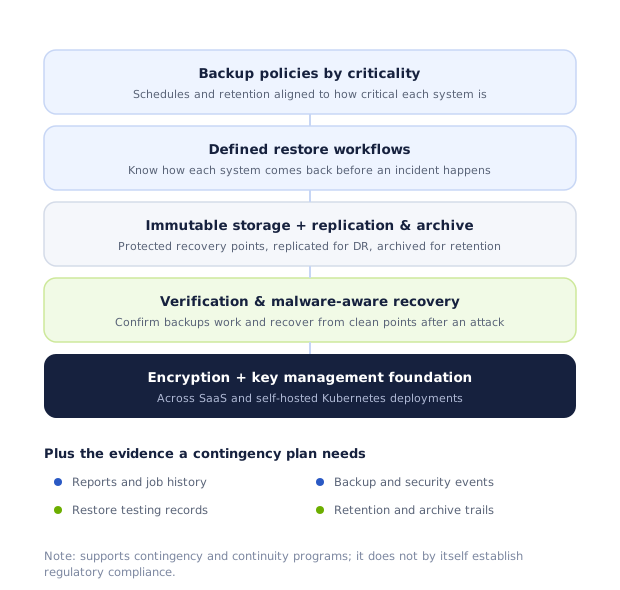
Healthcare IT teams often operate under tight budgets, limited maintenance windows, distributed sites, legacy systems, and high availability expectations. Backup infrastructure must be reliable without adding unnecessary operational overhead. DPX with vStor provides a software-defined backup repository model that can run on supported physical or virtual infrastructure. This helps teams build backup targets around performance, capacity, retention, and cost requirements. CloudCasa adds SaaS and self-hosted options for Kubernetes protection, giving platform teams a model that fits their governance and operating needs.

Resources covering workload coverage, ransomware recovery, immutability, and recovery verification.
Overview of DPX backup, rapid recovery, ransomware protection, vStor storage, archive, bare metal recovery, and remote office protection.
How vStor provides immutable snapshots, deletion lock controls, replication, archive, granular recovery, and flexible backup repository deployment.
How GuardMode detects ransomware-like behavior and data anomalies before backup and helps backup teams identify affected data.
Kubernetes, KubeVirt, OpenShift Virtualization, and cloud-native backup for healthcare teams that need self-managed deployment.
Catalogic helps healthcare IT teams protect physical systems, virtual infrastructure, NAS, databases, Microsoft workloads, Kubernetes platforms, and backup storage with practical recovery workflows and cyber-resilient architecture.
Request a Demo