


If you’re looking for a Commvault alternative in 2026, DPX by Catalogic is worth a look. Both platforms handle enterprise backup and recovery, but they differ in scope and licensing structure. Here’s what each one includes.
DPX and Commvault, a brief overview
DPX is Catalogic’s backup and recovery platform for physical and virtual environments. It covers VMware, Hyper-V, and Proxmox VE, with patented block-level backup for physical servers, agentless backup for VMware, Hyper-V, and Proxmox VE, and ransomware detection built into the core product. vStor, a software-defined, immutable backup repository, and GuardMode, which scans backups for ransomware activity traces and flags affected files for targeted recovery, ship with every DPX license at no additional cost. DPX also supports S3 and cloud archive destinations for offsite retention and disk-to-disk-to-cloud workflows, plus NDMP backup for NAS environments as a separately licensed add-on, priced from $20 per TB per month.
Commvault is a data protection platform. It includes backup and recovery, identity resilience for Active Directory and Entra ID, data and AI security and governance, and cyber recovery tools like threat scanning and Cleanroom Recovery. Commvault packages its platform in tiers: Operational Recovery is the base tier, Autonomous Recovery adds automation and replication on top of it, and Cyber Recovery adds threat scanning and cyber deception on top of that.
DPX vs Commvault, side by side
| Category | DPX | Commvault |
|---|---|---|
| Licensing structure | Single platform, one license | Tiered packages, Operational Recovery as the base, Autonomous Recovery and Cyber Recovery add capabilities on top |
| Ransomware detection | GuardMode, included with every license | Threat Scan, deeper malware-signature scanning, and Threatwise cyber deception all sit in the Cyber Recovery tier |
| Backup repository | vStor, included, no separate license | Not itemized as a standalone component on Commvault’s capabilities page |
| Proxmox VE | Agent on the host, none in VMs (added in 4.16), plus agent-based option for application-aware recovery | Supported through a Virtual Server Agent installed on the Proxmox node |
| Hypervisor coverage | VMware, Hyper-V, Proxmox VE, agentless across all three, Instant VM Restore for VMware backups | VMware, Hyper-V, Nutanix AHV, Proxmox VE |
| Reporting | Included, no additional cost | Metering and reporting included in the base package |
Proxmox support in more detail
DPX 4.16 added agentless backup for Proxmox VMs: full and incremental backups to vStor, node management, and job scheduling directly from the web UI, with no client installed inside each VM. DPX also supports agent-based Proxmox backup for workloads that need application-aware recovery, where the DPX client runs inside the guest VM. Both methods are available on the same platform.
Commvault added Proxmox VE support in its 2024E (v11.36) release. It installs a Virtual Server Agent on every Proxmox node, so no agent runs inside the guest VMs, which is the same model DPX uses with its plugin on the Proxmox host.
For the full walkthrough, see our step-by-step guide: How to Back Up Proxmox VE with Catalogic DPX.
Learn more about the platform itself on Proxmox’s official VE overview page.
Ransomware detection in more detail
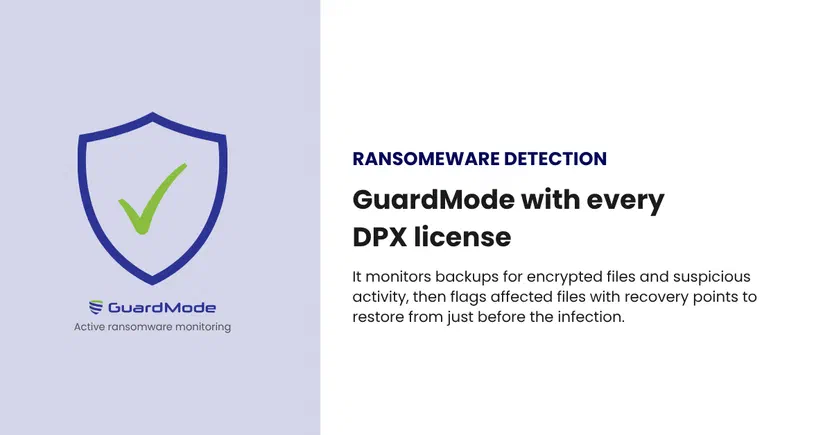
GuardMode is included with every DPX license. It scans backups for suspicious activity traces and encrypted files, and when it detects an issue, it gives you a list of affected files along with multiple recovery points so you can restore to just before the infection occurred. Backups can be stored as immutable snapshots, with offline, air-gapped copies available.
Read more about how GuardMode ensures backup data integrity in our dedicated blog post.
Commvault’s tier comparison chart lists Threat Scan, along with deeper threat scanning of backup data for malware signatures and Threatwise, its cyber deception tool, under the Cyber Recovery tier. The base Operational Recovery tier covers hybrid workload support, zero-trust architecture, and immutable storage, but not Threat Scan itself. Cleanroom Recovery, an isolated cloud environment for testing and forensics, is sold as a separate add-on on top of the Autonomous Recovery tier or above.
Which platform fits which situation
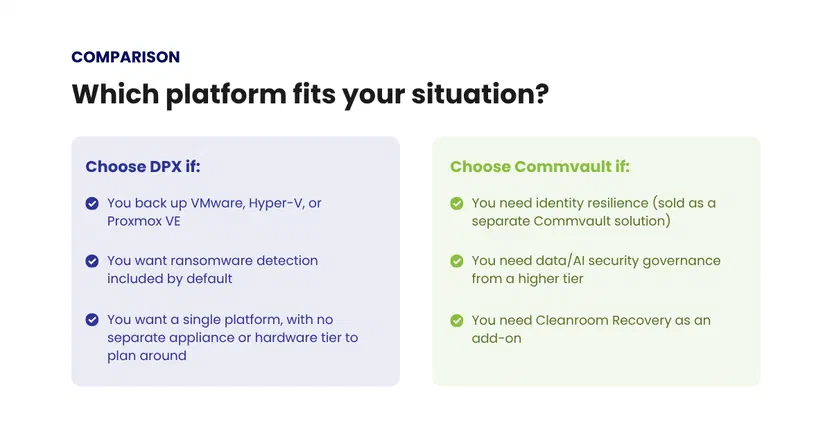
DPX fits teams that want data protection and ransomware detection across VMware, Hyper-V, and Proxmox without moving up to a higher Commvault tier to get it: GuardMode and the vStor backup repository come standard on every DPX license, while Commvault only bundles threat scanning into its top Cyber Recovery tier, above the base Operational Recovery package. The agentless Proxmox support added in 4.16 also covers mixed Proxmox and VMware or Hyper-V estates. DPX runs as a single software-defined platform, with no separate hardware appliance to size or buy into.
Data/AI security governance and Cleanroom Recovery sit behind Commvault’s higher tiers and add-ons, not the base platform: budget for that if you need them. Identity resilience is a separate Commvault solution area outside what either platform’s backup tiers cover.
Teams replacing Backup Exec rather than Commvault can start with our Backup Exec end-of-life guide, which maps its feature set against DPX capability by capability.
FAQ
Is there an alternative to Commvault in 2026?
Yes. Catalogic DPX is a backup and recovery platform that competes directly with Commvault on core data protection and ransomware defense, though Commvault’s platform covers additional ground in identity resilience and AI data security.
Does DPX support Proxmox?
Yes. DPX 4.16 added agentless backup and restore for Proxmox VMs, including full and incremental backups, node management, and scheduling from the web UI. DPX also supports agent-based backup for Proxmox guests that need application-aware recovery.
Is ransomware detection included with DPX?
Yes. GuardMode, DPX’s ransomware detection tool, is included with every DPX license at no additional cost.

Kacper Wasiak
GTM Manager
Kacper is GTM Manager at Catalogic Software, where he works with our product teams, developers and our partners to make sure our company's backup and recovery product values are well understood and presented in the digital universe. He writes about how data protection tools compare in practice, including backing up mixed hypervisor environments and what to evaluate before making any change to your data protection strategy.